Corn instead of history: how a chronicle hillfort near Pyriatyn is being plowed up

Source: ZMIST
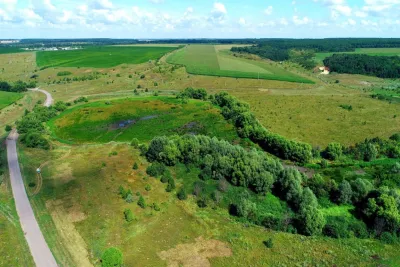
Thousand-year-old defensive ramparts are gradually being destroyed for corn crops. Despite documented damage to the slopes, land near the monument has been registered as private property. The prosecutor’s office and lawyers of the RMA are being brought into the case, while deputies are trying to find out why the local authorities and contractors have been unable to install even boundary markers for over a year.
A deputies’ appeal regarding urgent measures to preserve the archaeological monument “Hillfort and Settlement of the Chronicle Town of Polkosten” was considered at a meeting of the deputies’ commission on September 23.
The archaeological monument “Hillfort and Settlement of the Chronicle ‘Town’ of Polkosten” in Pyriatyn community is under threat of gradual destruction by agricultural machinery. During seasonal work, heavy tractors plow up the ramparts of the historical site, protective signs disappear, and in July 2026 part of the adjacent land was registered as private property by several families with the same surname.
During the meeting, deputies reported that despite meetings and site visits, farmers continue to creep up to the ramparts themselves. According to members of the education commission, the situation worsens every year because there are no protective boundaries in the field. Tractor drivers with nine-bottom plows or modern wide-span machinery cut into the slopes of the historical earthworks during their work. After previous inspections, an information stand and six protective plaques were installed on the site, but soon two of them disappeared, and the plowing continued.
Alongside the physical damage to the monument, a legal confrontation arose. On July 22, private ownership rights were officially registered for land plots that border the monument or partially overlap its probable protection zone.
The legal department of the Poltava RMA says that entering data into the state register does not guarantee indisputable acquisition of rights, since by law land under archaeological monuments belongs to the state. The lawyers cited an example of court practice from Kharkiv Oblast, where the state won back similar territories from private owners in court. However, to file a lawsuit, the lawyers need completed land management documentation with clearly defined boundaries of the monument and the lines where the plots overlap.
It is the documentation that has caused the greatest delay. The municipal institution “Center for the Protection and Research of Archaeological Monuments” of the Poltava Regional Council began work on preparing the registration documentation only this summer, although the task was set back in the spring of last year. The regional council funds this institution, yet the preparation of the papers has dragged on until October of this year, which is blocking the lawyers’ work.
During the commission meeting, a dispute flared up between deputies and representatives of Pyriatyn community. Head of the culture department of Pyriatyn City Council Serhii Valovazhenko said that the community had signed an agreement with the Center for the Protection of Archaeological Monuments and allocated funds in the budget for 2026:
“After the site visit in 2025, we were given the task of preparing the registration documentation. We planned funds in the 2026 budget, contacted the regional council’s Center for the Protection and Research of Archaeological Monuments in April and signed a contract with them. Now the documentation is nearly complete; they promise to hand it over in October. What has been done on our part: a stand and six protective plaques were made, and now four remain. They stopped plowing further because there is a ravine and a rampart there, but the corn keeps growing just as it did.”
Asked by deputies why the area is not physically fenced off and why officials do not stop machinery from driving in, Serhii Valovazhenko replied that he acts strictly within his powers:
“Explain what exactly the duty of looking after this monument includes. What am I supposed to do: put up a fence during martial law, or personally go and direct the tractors in the field? Where is that provided for by law? We are interested in preserving the site, the documentation is being developed, the protective signs were ordered. It feels like the regional council is not supporting the community but simply hounding it.”
In turn, head of the land department of Pyriatyn City Council Yevhenii Stadnyk explained that seizing these plots from private ownership would be an unlawful and unrealistic step:
“We consulted with the developers of the land management documentation from Poltava. After the documents are prepared, ownership of the adjacent land shares is not taken away. Only a restriction on the use of the territory is introduced. An attempt to take shares away from people is illegal, especially since the community has no free land to allocate as compensation for these plots. The farm’s land was divided into shares back in 2001. So this is solely about establishing protective restrictions.”
Commission chair Ivan Didenko disagreed with this position. He believes that officials’ passivity is leading to the destruction of the earthworks:
“When a 500-horsepower tractor with nine bottoms goes in there, you won’t have time to blink before it cuts away two meters of rampart. We went to the site and asked the farmers to back off; as soon as we drove away, they plowed right up to the hill again. Clear boundary markers need to be driven in, the line has to be staked out, an agreement must be reached with the tenants, or temporary barriers must be installed before every sowing season, instead of turning a blind eye. Land of archaeological monuments must be returned to the state through the courts.”
Following the review, the commission decided to summon the management of the Center for the Protection and Research of Archaeological Monuments to its next meeting in October with a report on the readiness of the documentation. Once the boundaries are determined, they want to work out, together with the RMA’s legal department, the issue of forcibly returning the land to the state or establishing strict regime restrictions, and to send a package of materials to law enforcement to check the legality of the registration of ownership rights and the fact of damage to the monument.
More articles