In the Poltava Region, a Kyiv woman has bought back her Cossack great-grandfather's century-old estate and is calling for a volunteer work bee
Source: ZMIST
An estate in Lokhvytsia, nationalized by the Soviet authorities back in 1929, has been returned by a descendant of an old Cossack family. It took almost 10 years of struggle.
The new owner has completed the paperwork and responded to critics about the building’s historical value after Suspilne aired a story about her plans. The Kyiv woman is now looking for volunteers to clear the rubble and mothball the house for the winter. Yanina Alieieva talked about all this on her Facebook page.
From confiscation to the community’s first small-scale privatization
The story of getting the property back lasted almost a decade. The estate once belonged to the Horoshko Cossack family. Yanina’s great-great-grandfather, Sava Horoshko, was well known in Lokhvytsia, and her great-grandfather Vasyl was a patron and the warden of the first autocephalous St. John’s Church.
In 1929, the Bolsheviks arrested Vasyl Horoshko for his church activities and exiled him to Kazakhstan, and the entire complex was taken away. According to the records of the commission for restoring the rights of the rehabilitated, the Soviet authorities confiscated the house, two stone sheds, two granaries with a cellar, and a mill with foreign equipment, which was later dismantled and moved.
In Soviet and post-Soviet times, the premises were occupied by a collective farm yard, a dormitory and an agricultural enterprise. When the buildings were abandoned, they began to fall apart. The Horoshkos’ great-granddaughter tracked down the last users, got them to waive their claims to the complex and initiated recognition of the property as ownerless through the Lokhvytsia City Council. Eventually, the estate was put up for a privatization auction.
She managed to register ownership at the end of September thanks to the help of caring people who joined the fundraiser for the purchase. The agreement was signed together with Lokhvytsia Mayor Viktor Radko. According to the owner, this was the first successful case of small-scale privatization in the Lokhvytsia community.
“The ceiling is on the floor, where grass is growing.” The real state of the estate
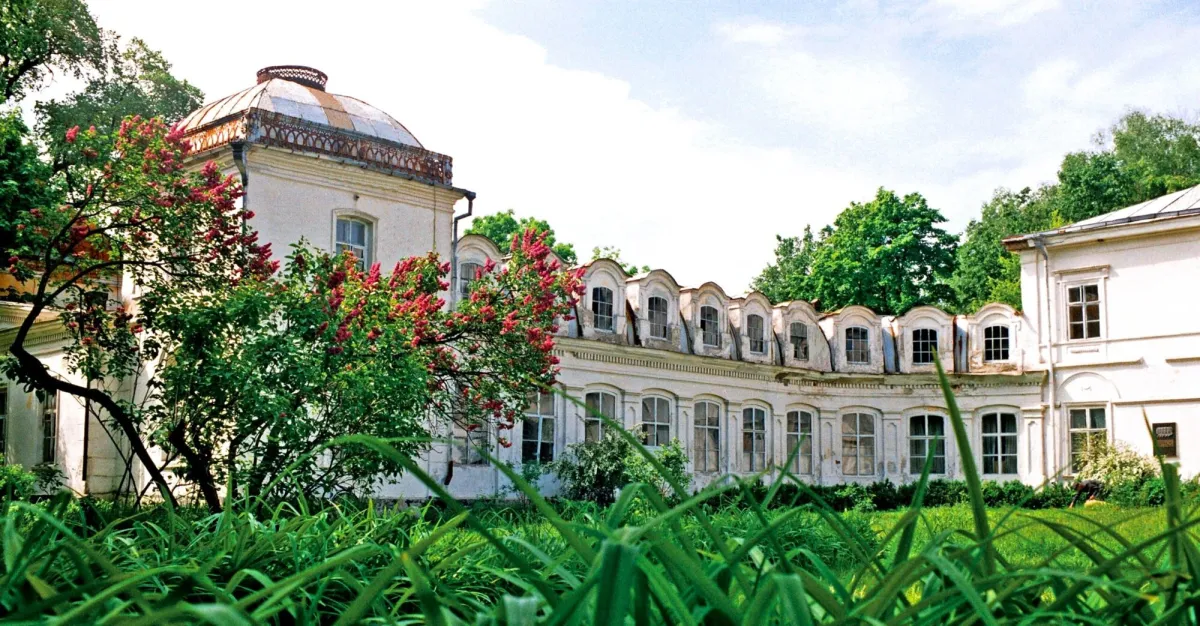
The complex consists of a 1905 house and a wooden storehouse with columns, built without nails over 100 years ago.
Although the rooms still partly retain authentic ceiling rosettes, stucco molding, an antique wardrobe and a chest, the house itself is in a dangerous state of disrepair. At some point, unknown people broke two indoor stoves, causing the massive brick chimneys to sag and damage the roof. Now the ceiling in one of the rooms has collapsed completely, and grass is growing through holes in the roof. The floors are covered with remnants of rotten beams, lath and construction debris left from numerous Soviet-era remodelings:
“An estate does not automatically mean the scale of the Kochubeis. Between a clay hut and a palace there were also intermediate architectural scales, decorated in the style of the time. It is precisely the class of this estate that is very valuable, because it represents the prosperous life of the provincial intelligentsia, not the everyday life of a peasant or the palace of a nobleman. The estate is valuable as a whole complex of decorated brick buildings, few of which have survived”, Yanina Alieieva emphasizes.
Work bee in Lokhvytsia
At the moment, the building has neither electricity nor water. The owner’s top priority before the cold sets in is to clear the rubble inside, carry out conservation work and board up the broken doors with plywood and cover the windows with plastic sheeting. During the cleanup, the first finds turned up, including a collection of antique footwear that is planned for a future museum exhibition.
The first cleanups are scheduled to begin on Saturday, October 17. Local residents and anyone who wants to support the project are invited to take part. You can come and help rake and carry out debris and clear the floors down to the original layer. Shovels, crowbars, construction wheelbarrows, bags, plywood and plastic sheeting for covering window and door openings are also needed. Anyone can also bring thermoses with hot tea or coffee, and the owner will provide snacks.
Going forward, the rescued estate is not meant to be preserved as a private home; the plan is to turn it into a public cultural, tourism and rehabilitation space for the Lokhvytsia community. Anyone who wants to join the work bee can contact Yanina Alieieva through her personal Facebook page.